By Chris Ballam
— a Utah-based backpacker and three-time Scoutmaster who has backpacked Coyote Gulch firsthand multiple times, sharing outdoor and travel guides from 29 countries.
Last updated: October 8, 2026
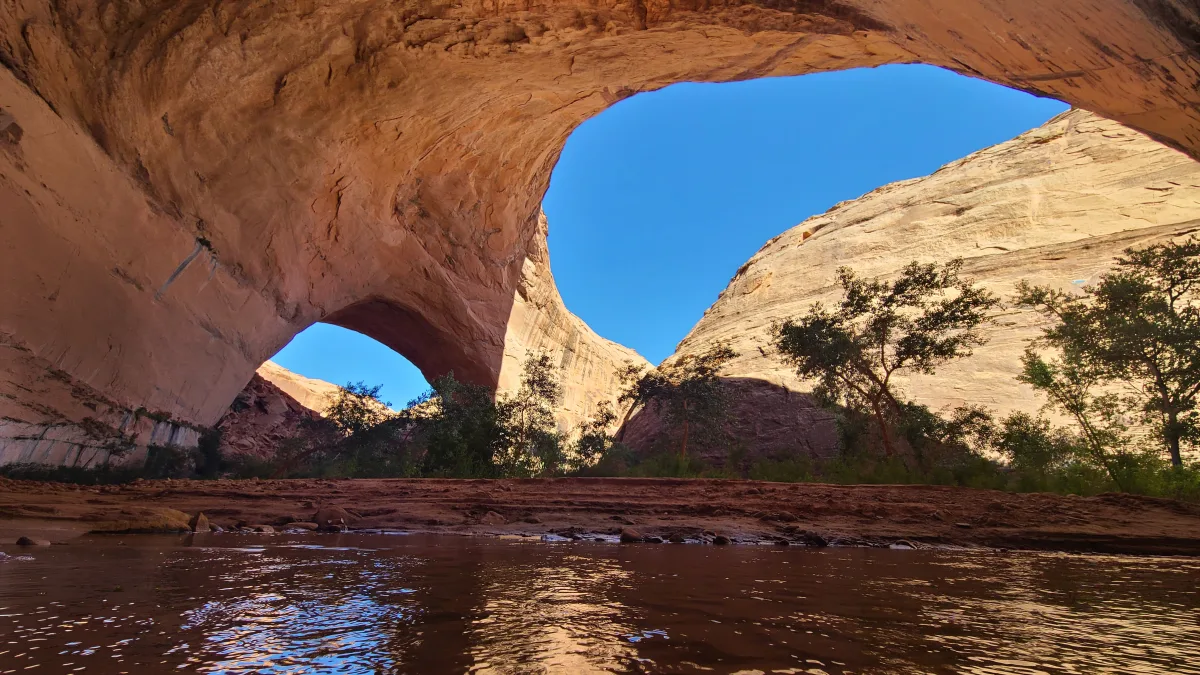
Jacob Hamblin Arch over Coyote Creek, Grand Staircase–Escalante — Coyote Gulch, Utah.
Quick Answer: How to Backpack Coyote Gulch
For a 4-day backpacking trip through Coyote Gulch in Grand Staircase-Escalante National Monument (Utah), the essentials are: a backpacking pack (40–65L), lightweight tent, sleeping bag and pad, water shoes for stream crossings, water filter, Jetboil, WAG bags (required — all human waste must be packed out), headlamp, sun protection, and 2 breakfasts, 2 lunches, and 2 dinners per person plus snacks.
Coyote Gulch at a Glance
Distance
13 miles (4-day loop)
Days
4 days / 3 nights
Difficulty
Moderate; some exposure
Best season
Spring & fall
Entry trailhead
Crack-in-the-Wall
Exit trailhead
Water Tank
Water
Year-round creek (filter)
Permit
Free; required overnight
Group limit
12 people
Dogs / Horses
No pets permitted
Campfires
Not allowed
Waste
Pack out (WAG bags)
This Coyote Gulch backpacking guide covers everything you need for a 4-day backpacking trip through Grand Staircase-Escalante National Monument in Utah, including gear, food, clothing, and safety items. You may already have many of the items, or know others who would let you borrow them, so there is no need to buy new ones if you do. You can also find most of these items locally at places like Recreation Outlet, REI, Scheels, etc. For larger, more expensive items like backpacking backpacks, shoes, etc., I would recommend trying on those things at a brick and mortar store to make sure they fit well before purchasing them.
Each person is responsible for bringing the following:
2 breakfasts (no refrigeration needed)
2 lunches (no refrigeration needed)
2 dinners (no refrigeration needed)
Snacks for 3 days (no refrigeration needed)
Shared Tent - Coordinate with 1-2 others
Shared Jetboil - Coordinate with 1-2 others
Your own backpacking gear & clothing
See the packing list and itinerary below for the suggestions of what gear, clothing, food and snacks to bring (Non-perishable, dehydrated meals, etc.). All other meals while we are not inside Coyote Gulch will be provided by the group (2 restaurants & 2 group meals).
How to Get to Coyote Gulch: Trailheads & Route Options
Coyote Gulch sits inside Grand Staircase–Escalante National Monument and Glen Canyon National Recreation Area in southern Utah. Every route starts from Hole-in-the-Rock Road, a graded dirt road that leaves Highway 12 about five miles east of the town of Escalante. The first ~36 miles are usually passable in a normal car when dry, but the road turns to slick, impassable clay when it rains — check the forecast before you commit.
There are four ways into the gulch. I've always used Crack-in-the-Wall in / Water Tank out, but the right choice depends on your comfort with exposure and how quickly you want to reach the arches.
The four Coyote Gulch trailheads
There are four primary trailheads for Coyote Gulch: Hurricane Wash (easiest, no technical scrambling), Red Well (longer wash walk), Crack-in-the-Wall (scenic lower-canyon entry requiring rope/webbing to lower packs), and the Water Tank Sneaker Route (steepest and shortest, requiring a static rope or friction scrambling on sandstone).
Route
Trailhead
Approximate distance to the gulch
Difficulty
Best for
Hurricane Wash
Hole-in-the-Rock Rd (~34 miles)
~5.5 miles to confluence
Easiest — no descent
First-timers, no exposure
Red Well
Hole-in-the-Rock Rd (~30 miles)
~7 miles to confluence
Easy — slightly longer
Quieter start, meets Hurricane Wash
Crack-in-the-Wall
Fortymile Ridge Rd
~2.5 miles across slickrock to the crack
Moderate — squeeze + lower packs
Fastest to lower gulch & arches
Water Tank (Sneaker Route)
Fortymile Ridge Rd
~2 miles + steep slickrock
Hardest — static rope or friction scramble
Direct to Jacob Hamblin Arch
Hurricane Wash is the most popular and forgiving entry: a long, flat, sandy wash walk with no scrambling, ideal if you're new to canyon backpacking or carrying heavy packs.
Red Well starts a few miles up the road and joins Hurricane Wash — slightly longer, usually less crowded.
Crack-in-the-Wall and Water Tank both leave from Fortymile Ridge Road, a rougher, sandy spur that a high-clearance vehicle handles far better than a sedan. Crack-in-the-Wall drops you into the lower gulch through a narrow slot in the cliff — narrow enough that you'll need to lower your pack by rope or webbing before squeezing through. It puts you closest to Coyote Natural Bridge, Cliff Arch, and Jacob Hamblin Arch. The Water Tank "Sneaker Route" is the shortest line to Jacob Hamblin Arch but involves a steep slickrock friction descent — grippy shoes and a steady head for exposure matter here; many hikers use a hand line.
My preferred route: I drop in via Crack-in-the-Wall on Day 2 and climb out the Water Tank sneaker route on Day 4. See the 4-day itinerary below for the day-by-day details.
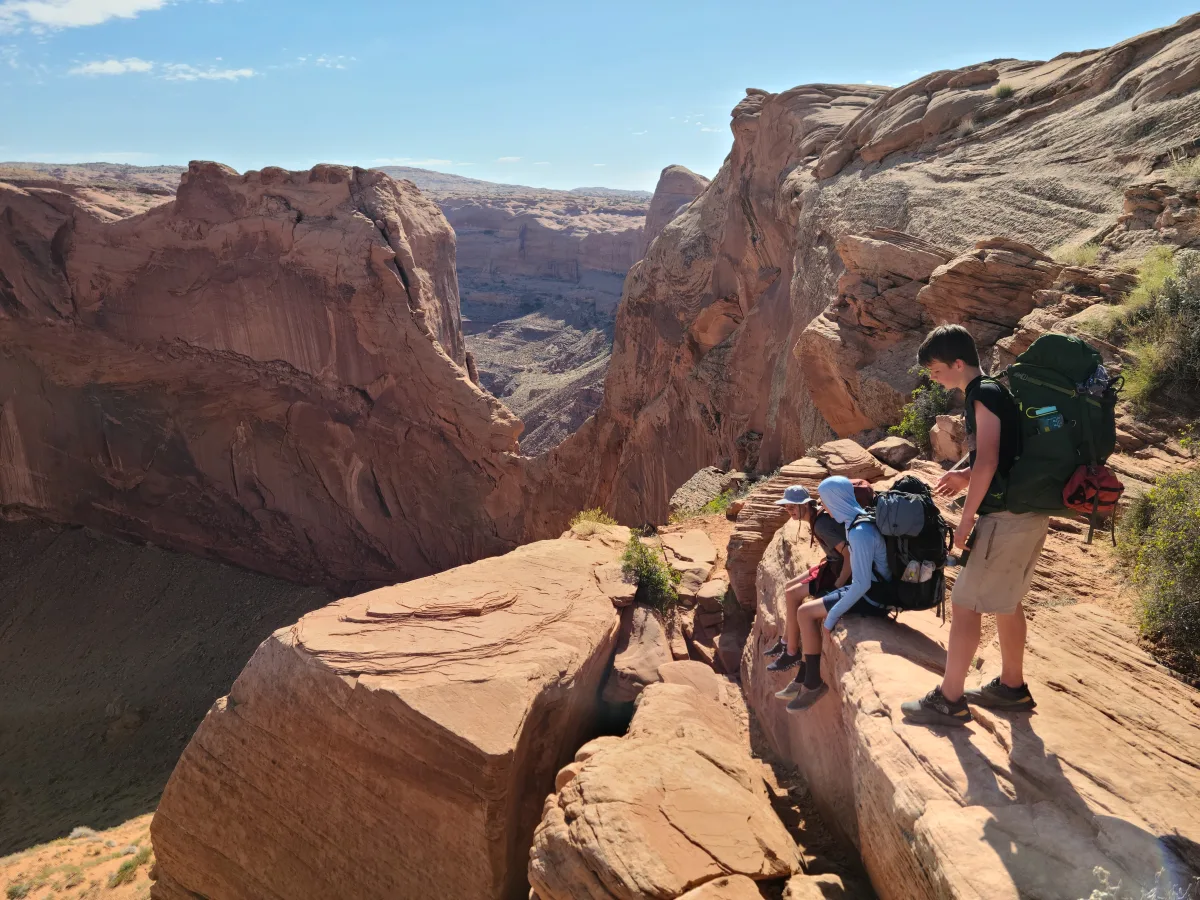
Lowering packs through Crack-in-the-Wall into Coyote Gulch.
Do you need a permit?
Yes — a free backcountry permit is required for all overnight trips. Get a permit at the Escalante Interagency Visitor Center in Escalante, or self-register at the trailhead self-issue stations before you enter the gulch. Day hiking does not require an overnight permit. The current group-size limit is 12, and online reservations are not available. If your group is larger than 12, you must split into groups of 12 or fewer and hike and camp at least 1/2 mile apart. Group-size limits are strictly enforced — permits are denied and violators are cited if limits are exceeded. Also check the National Park Service website for the latest Coyote Gulch information.
Coyote Gulch Trail Map
The map below shows my Crack-in-the-Wall entry, the route up Coyote Creek past Jacob Hamblin Arch, and the Water Tank sneaker-route exit, with camps and the major arches marked. Download the GPX to load the exact track on your phone or GPS.
Coordinates and the GPS track are approximate — always carry a downloaded offline map; there is no cell service in the gulch.
Best Time to Backpack Coyote Gulch
The best time to backpack Coyote Gulch is spring (April–May) and fall (mid-September–October), when daytime temperatures are comfortable, the creek is manageable, and flash-flood risk is lower. These shoulder seasons give you the best combination of weather, water level, and smaller crowds.
Season by Season
Spring (April–early June): My favorite window. Mild days, cool nights, cottonwoods leafing out. Snowmelt can raise the creek and chill the water crossings early in the season, so expect wet feet.
Summer (mid-June–August): Hot — often 90–100°F on the exposed approaches — and this is monsoon season, when afternoon thunderstorms drive the highest flash-flood danger. Because of the extreme heat and elevated flash-flood risk, summer is for very experienced desert backpackers only. If you go, start early, watch the sky, and know your escape points. (See the flash-flood safety FAQs below.)
Fall (September–October): The other prime window. Warm days, cold nights, low water, and the year-round creek still flowing. Crowds thin out after Labor Day.
Winter (November–March): Quiet and beautiful but cold. Frigid water crossings, freezing nights, and Hole-in-the-Rock Road can be impassable after storms. For experienced desert winter backpackers only.
Because Coyote Creek flows year-round, water availability is never the limiting factor — season, temperature, and flash-flood risk are. Plan around those.
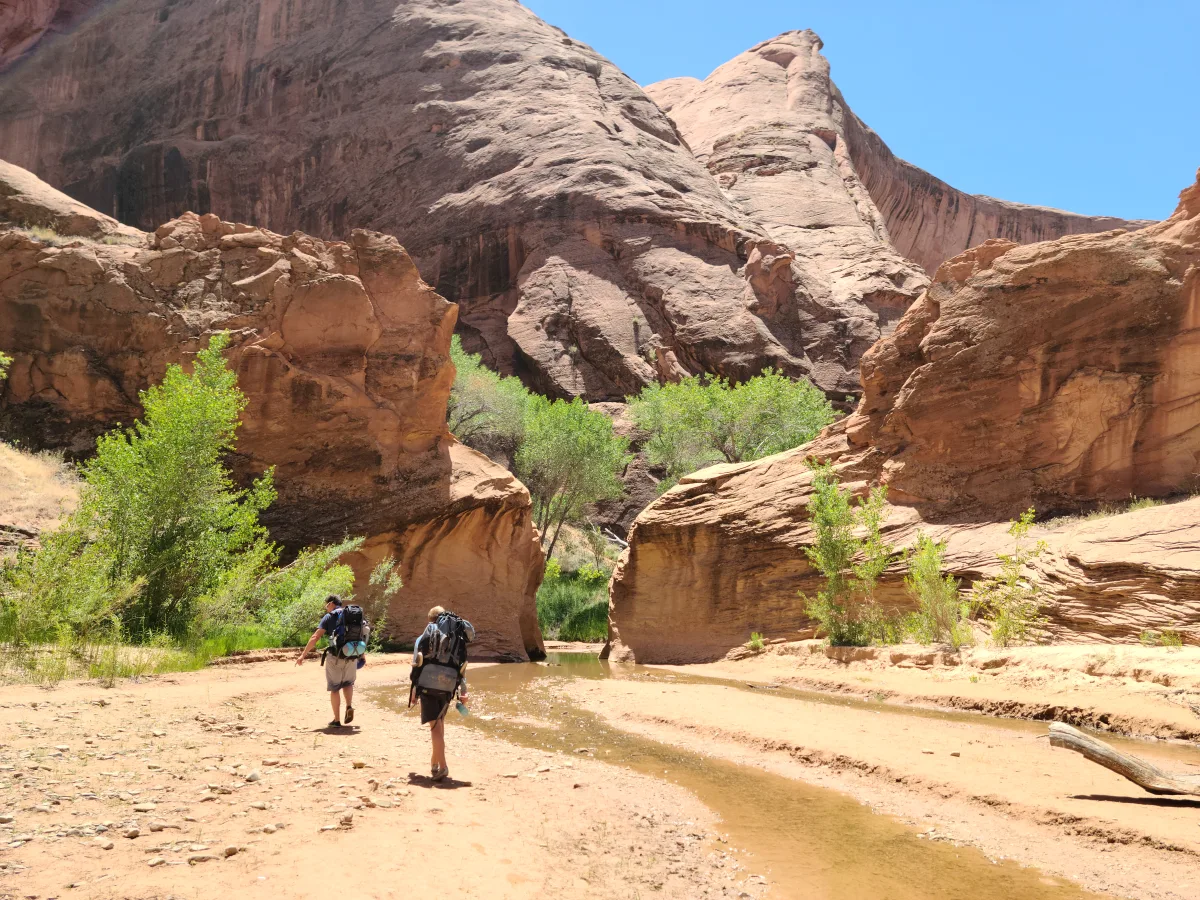
Coyote Creek beneath the canyon walls in late spring.
There are many different kinds of backpacking backpacks available ranging from $50-$600. Find one that fits you and is lightweight. You don't need a pack with lots of storage space...just enough for your tent, clothing, food, and other gear. I also recommend going somewhere like REI, Scheels, or the Recreation Outlet to try on a backpack before purchasing one to make sure it will adjust to fit you just right. I personally like internal frame backpacks, but that's personal preference. My favorite backpack is the Osprey Atmos AG LT 65L.
Headlamps are needed at night to find your way to your tent and to see frogs, etc. You could also bring a flashlight if you prefer those over headlamps.
It is best to take a lightweight, small 2-3 person tent. Larger tents are not good for this trip because they are bulky and heavy to carry on your back. We plan to have 2 people in each tent so pair up with another person or two and you can share the weight of the tent in your backpacks. A 3-person is great for 2 people + packs. This Kelty tent is more affordable and weighs 5lb 7oz. If you want an ultralight 3 person tent that only weighs 3.94 lbs., my all-time favorite backpacking tent and the last tent I took to Coyote Gulch is the Big Agnes Copper Spur UL tent. The Copper Spur UL is expensive because it is so lightweight and compact. There are many other tents available which would work for Coyote Gulch.
Reusable water bottle, about 1 liter and/or CamelBak-style water reservoir (we will be hiking in a riverbed so we will have plenty of access to fresh water)
This is a requirement because we will need to filter all our water while we are in the Gulch. There are a few springs in the Gulch, and we will also filter the river water. Get familiar with how the water filter works before going on the trip. There are many different options for water filters. Everything from lightweight and compact to heavier and bulkier. They also vary widely in price. I have had good success with the Sawyer Products squeezable pouches because they are very lightweight and inexpensive. Others prefer filters like the Katadyn BeFree, Katadyn Hiker Pro, MSR MiniWorks EX, etc.
Camp Shoes
Shoes
Camp shoes like lightweight Crocks, soccer sandals, and flip flops are optional. DO NOT plan to hike in these types of shoes if you bring them.
Trail Runners or Tennis Shoes
Shoes
Trail runners or tennis shoes that are lightweight and dry quickly. If you choose to also use your tennis shoes or trail runners in the water (like I do) you need to bring a few changes of socks (at least 2 pairs per day). Big hiking boots are not the best choice for this trip. These trail runners or tennis shoes will be used when we are hiking across the desert to get in and out of the gulch. Shoes should have good grip to climb steep rock faces on the hike out.
Water Shoes like Teva's or Chacos
Shoes
You will have wet feet for half of the trip and the entire time we are in the gulch. You can wear tennis shoes or trail runners in the water, or you can bring strappy sandals like Teva's or Chacos. Teva's or Chacos are great but make sure you are used to them beforehand, so you don't get blisters. Both times I have done Coyote Gulch I used Trail Runners with good grip the entire time along with 2 pairs of lightweight wool socks per day (I also had lightweight camp shoes for nights inside the gulch when we were in camp and out of the water.
You will be in the sun a lot on this trip. A hat and sunscreen will help keep you from getting sunburned.
Hiking Pants
Clothing
Hiking pants prevent sunburn while you're hiking across the desert. Some people like to take hiking pants where the bottoms zip off for when they're hiking in the water.
Hiking Shorts
Clothing
Lightweight, quick drying shorts work great
Long Sleeve Sun Shirt
Clothing
Long sleeve sun shirts can prevent your arms from getting sunburned
Mid-Layer or Jacket/Puffy
Clothing
It will get down to around 50s-60s at night so it's nice to have a jacket after the sun goes down.
Some people prefer neoprene socks over wool socks. Neoprene is the same material wetsuits are made from and can keep your feet warmer than wool socks. I haven't tried neoprene socks myself, but some people really like them.
Moisture-wicking shirts are great for hot weather to wick away your sweat, etc. They also dry quickly. A regular t-shirt can also be used for this; it just won't dry as fast and may feel hotter than a moisture-wicking shirt.
Sunglasses (inexpensive)
Clothing
Sunglasses are nice, but I wouldn't take expensive sunglasses in case they fall off into the river or something.
Swimsuit
Clothing
Many people hike Coyote Gulch in swimsuits because they dry quicker than normal shorts. If you choose to hike in your swimsuit, make sure it is comfortable and won't be causing chafing, etc.
Underwear
Clothing
Make sure you bring enough underwear for the entire trip, including extra for the times you might fall into the water.
Wool socks are great for water because they remain warm when wet. If you take wool socks, take lightweight, hiking wool socks like this example. I've had great luck with merino wool socks or merino wool blends because they are more comfortable for my feet. Also, try hiking in these socks before going on the trip to see if they cause blisters for you, etc. If you are hiking in the water with your wool socks on, make sure you bring 4-5 pairs so when you get out of the water you can dry your feet off and put on dry socks.
Sometimes rodents or birds will try to get your food or trash if it's left unattended. If rodents can smell your food they can chew through tents and packs to get to it. Rodents can smell food through Ziploc bags, but not through an odor-proof bag. Watch Mark Rober's squirrel videos to see how smart they are. Ravens are also common in Coyote Gulch and have been filmed unzipping backpacks or pecking though fabric to get to food or trash. These 12 x 20 inch OPSAK bags are bigger than a 2-Gallon Ziploc bag so you can fit quite a lot inside one. An odor-proof bag isn't rodent-proof, but it will help a lot. If you want something that is completely rodent-proof then you would need to get an Ursack or a stainless steel mesh bag, but those are more expensive and may not be necessary.
We need to pack out EVERTHING we take into Coyote Gulch. What has worked well in the past is packing your meals for each day in 2 gallon Ziploc bags and label them accordingly with your name & day. That makes it easier to just grab it out of our pack, eat it, and then put all the garbage into the Ziploc bags.
These are optional, but they are nice if your body odor gets overbearing after a few days without a shower, sweating in the sun. These body wipes SHOULD NOT be put in the compostable toilet, and they SHOULD NOT be buried in the sand. If you use these make sure to pack them out with your other garbage.
Jetboils are great for this trip. I like the Jetboil MiniMo because the fuel canister and stove fit nicely inside the cooking cup and it's not too big. A single Jetboil can be shared by one or two others, so coordinate with someone else going on the trip.
A separate cup for hot cocoa or hot cider or instant oatmeal is nice to have. I like having a separate cup for mixing drinks and for instant oatmeal. That way I can use my jetboil only for boiling water and I don't have to clean it out before I put the Jetboil stove back inside the pot.
If you bring a Jetboil, make sure to also bring a Propane Fuel Canister that fits it. This will be used to boil water for 2-4 meals and hot cocoa, etc. for each person (only 2 if you're eating a cold breakfast).
Electrolyte flavor packets are great for hiking because they help prevent cramping, headaches, etc. They also adds some flavor to the water we will be filtering. There are a lot of different brands for this like Gatorade, Propel, Nuun, DripDrop, LMNT, Liquid I. V., Ultima, Bodyarmor, etc.
Energy chews can be good to restore electrolytes and provide energy boosts while hiking. These mountain berry bloks don't contain caffeine, but other flavors do. There are also other similar products like energy gels, energy bars, etc.
Each person needs to bring 2 breakfasts for inside Coyote Gulch. We will have these 2 breakfasts at our camp which means we will have boiling water for things like freeze dried meals, hot-cocoa, instant oatmeal, etc.
Each person needs to bring 2 dinners for inside coyote Gulch. Freeze dried meals like the Mountain House meals where you just add boiling water work great for this trip. See the FAQ below for details about how many servings you need which talks about trying these meals before you go to find which ones you like and how much you need.
Each person needs to bring 2 lunches for inside Coyote Gulch. We will not be boiling water for these meals; we will just stop on the side of the trail. It's best to bring food that doesn't melt or explode in the heat. Take whatever you like and will eat. High calorie snacks like Cliff Bars, trail mix, nuts, dried fruit are great if you like those. Some ideas for protein are tuna or chicken packets, jerky, pepperoni sticks, etc. These lunches will not be refrigerated and will be in the backpacks for a day or two, so don't take things that will spoil, etc.
Energy bars are the easiest calories to eat on the move — one in a hip-belt pocket keeps you going between water stops without stopping to dig through your pack. These CLIF bars are made with organic oats for a steady carb hit, and unlike a chocolate-coated bar they hold their shape in the Coyote Gulch heat instead of melting or turning to mush.
Jerky is your protein and salt in one — and in a canyon where you're sweating hard for four days, the salt actually helps you hold onto the water you drink. It won't melt, won't get crushed, and needs no refrigeration. The individual 0.625 oz bags are the real win: each one stays sealed until you open it, so nothing goes stale or greasy in your pocket or the bottom of your pack.
Trail mix is the classic backpacking snack because it packs carbs, fat, and salt into a handful you can eat while walking. Go easy on the chocolate or things that melt in the heat (M&Ms are usually OK if it's not too hot) — and this Kar's Sweet 'N Salty mix leans on peanuts, raisins, and sunflower kernels that shrug off the heat. The 2 oz grab pouches make it easy to ration a couple per day instead of burning through one big bag on day one.
Bugs aren't an issue early in the season, but as it gets later in the year, they will come out. With this year being so dry they may be out earlier than normal so make sure you have some bug spray.
Sunscreen is a must on this trip. Especially when we are hiking across the desert to and from Coyote Gulch because there is zero shade. In Coyote Gulch there is shade depending on the time of day and location, but you will also need sunscreen inside Coyote Gulch even if you're wearing a hat because the sun reflects off the water, etc.
Small, travel-size toilet paper, not a normal sized roll of toilet paper. Whatever toilet paper you use must be packed out with you along with any human waste. The only exception to this is in the one and only compostable toilet.
For chafing prevention and treatment. Anti Monkey Butt Anti-Chafing sticks, powders, or ointment work well. This is marked as optional because not everyone needs this, but if you do, you're glad you have it.
GoPros are waterproof and durable and work great in Coyote Gulch. Make sure your batteries are charged. This GoPro is one of the most affordable GoPros. There are also some higher-end GoPros like the GoPro HERO13 Black, but those are a lot more expensive.
Trekking poles, sometimes called hiking poles can be nice to keep your balance while walking through the river. If you take trekking poles, make sure they collapse down nicely so you can put them in your pack or tie them onto the outside of your backpack for times when we are hiking down into the gulch, or back out of the gulch.
Some people like to take a waterproof point and shoot camera for photos or videos in Coyote Gulch. This OM SYSTEM Olympus Tough TG-7 camera is on the expensive side, but it's really durable, waterproof, takes 4K Video, and it has integrated GPS to embed the location of the photo into the photo (or you can disable that).
Coyote Gulch Trip Overview
This is my favorite way to do a 4-day backpacking trip through Coyote Gulch, Utah in late May or early June before it gets too hot. I have taken two different groups of young men and adults on this trip over the past few years and both trips were amazing. I start our trips by hiking though some short slot canyons in Grand Staircase-Escalante National Monument. The next morning, we drop down into Coyote Gulch and spend the next two days and nights hiking upstream in Coyote Creek surrounded by towering Navajo sandstone walls taking in some breathtaking scenery (Jacob Hamblin Arch, Cliff Arch, Stevens Arch, Coyote Natural Bridge, and Hamblin Alcove). I've backpacked a lot of places in Utah and the surrounding states, and this is definitely one of my favorite places to go.
Peek-a-Boo Slot Canyon and/or Spooky Slot Canyon
Entry trailhead: Crack in the Wall (Fortymile Road)
Exit trailhead: Water Tank
Hiking day 1: 3 miles
Hiking day 2: 5.5 miles
Hiking day 3: 2.25 miles
Hiking day 4: 2 miles Total hiking distance: 13 miles
Walking to camp near Jacob Hamblin Arch, Coyote Gulch (26s).
4-Day Coyote Gulch Itinerary
Day 1: Drive to Escalante & Slot Canyons
7:30 AM
Leave for Coyote Gulch
12:00 PM
Lunch at a restaurant on the way (group provided)
1:00 PM
Drive to Slot Canyons
2:00 PM
Hike Peek-a-Boo Slot Canyon or Spooky Slot Canyon (2 or 3 miles roundtrip)
4:30 PM
Drive to Crack in the Wall Trailhead (Fortymile Ridge)
5:30 PM
Arrive at Crack in the Wall Trailhead & set up camp
7:00 PM
Dinner (group provided)
Day 2: Drop into Coyote Gulch via Crack-in-the-Wall
6:00 AM
Breakfast (group provided)
7:00 AM
Start Hike to Crack in the Wall (2.5 miles)
9:00 AM
Arrive at Crack in the Wall, lower packs down, and hike to Escalante River (0.75 miles)
10:00 AM
Arrive at Escalante River and start the hike up (north/west) the river to 1st camping spot (2.25 miles)
10:45 AM
Start hiking up Coyote Creek as it enters Escalante river from your left (west)
12:00 PM
Stop on the trail for lunch (bring your own lunch). We're not getting camping stoves out, so lunch should not require boiling water.
1:00 PM
Hike to 1st camping spot somewhere along Coyote Creek
3:00 PM
Arrive at 1st camping spot and set up camp
4:00 PM
Explore area and filter water
6:00 PM
Dinner (bring your own dinner). We will be boiling water, so dehydrated meals and hot cocoa/cider work great.
Day 3: Hike up Coyote Creek to Jacob Hamblin Arch
8:00 AM
Breakfast (bring your own breakfast). We will be boiling water, so dehydrated meals and hot cocoa/cider work great.
9:00 AM
Pack up camp and start hiking up Coyote Creek to Jacob Hamblin Arch (2.25 miles)
12:00 PM
Stop on the trail for lunch (bring your own lunch). We're not getting camping stoves out, so lunch should not require boiling water.
3:00 PM
Arrive at 2nd camping spot at Jacob Hamblin Arch and set up camp
4:00 PM
Explore area and filter water
6:00 PM
Dinner (bring your own dinner). We will be boiling water, so dehydrated meals and hot cocoa/cider work great.
Day 4: Climb Out of Coyote Gulch via Jacob Hamblin Sneaker Route to Water Tank Trailhead
7:00 AM
Breakfast (bring your own breakfast). We will be boiling water, so dehydrated meals and hot cocoa/cider work great.
8:00 AM
Pack up camp and start the hike out of Coyote Gulch up to the Water Tank trailhead (2 miles)
10:30 AM
Arrive at Water Tank trailhead, pack up trucks, retrieve 1 truck still at the Coyote Gulch Trailhead (Fortymile Ridge) and drive home
2:30 PM
Arrive in Torrey, Utah, eat late lunch (group provided)
The best time to go to Coyote Gulch is in the Spring (April - early June) and Fall (mid-September - mid-November). Outside those windows it will be way too hot in the summer, and very cold in the winter. One very important weather related item in addition to the time of year is to always check flash flood forecasts and monsoon patterns regardless of season. Storms in the area or upstream from Coyote Gulch can cause dangerous flash floods with little warning and you will not have phone service unless you bring a satellite phone or Starlink.
How many miles do you hike?
On my recommended four-day trip you will hike a total of about 13 miles. That's 3 miles on the first day, 5.5 miles on the second day, 2.25 miles on the third day, and 2 miles on the last day. Almost all of these miles are over mostly flat terrain as we walk up Coyote Creek which will have low impact on the joints, but high impact on your experiences and memories.
How long does it take to hike Coyote Gulch?
Plan on 2 to 4 days. Most backpackers do 3 days and 2 nights covering roughly 20 to 26 miles round trip, depending on which trailhead you start from. My recommended route is a relaxed 4 days over about 13 mostly flat miles up Coyote Creek. Strong hikers can reach the Jacob Hamblin Arch area and back as a long 14-mile day hike from Hurricane Wash.
Can you do Coyote Gulch in a day?
Yes, but only as a long, strenuous out-and-back. From the Hurricane Wash trailhead it is about 14 miles round trip to Jacob Hamblin Arch and back. Start before dawn, carry plenty of water, and check the heat and flash-flood forecast first. To actually enjoy the arches, natural bridge, and waterfalls, plan at least one overnight instead.
Where can I camp in Coyote Gulch?
Camp at dispersed, primitive sites on the sandy benches above Coyote Creek. There are no developed campgrounds. The most popular sites cluster near Jacob Hamblin Arch, Coyote Natural Bridge, and Cliff Arch. Camp on durable sand well back from the water, follow Leave No Trace, pack out human waste in a WAG bag, and keep your group to the 12-person limit. An overnight backcountry permit is required.
Is Coyote Gulch the best backpacking trip in Utah?
Coyote Gulch is widely considered one of the best beginner-friendly backpacking trips in Utah. The mostly flat 13 to 26 mile route, a year-round creek, and a rare concentration of arches, a natural bridge, and waterfalls deliver a huge payoff for modest effort. It is my top recommendation for a first backpacking trip in the Grand Staircase-Escalante area.
What shoes should I bring?
We will have wet feet for half of the trip and the entire time we are in the gulch. My recommendation is to bring tennis shoes or trail runners and if you don't want to wear those same shoes in the water as we walk up the creek, you can also bring strappy sandals like Tevas or Chacos. If you are wearing tennis shoes or trail runners in the water, make sure to bring a few changes of socks (at least 2 pairs per day). On my last trip I wore trail runners the entire time both in and out of the water and they worked great. I also had some camp shoes for in camp when my shoes were drying. Big hiking boots are not the best choice for this trip. Camp shoes (lightweight like Crocs, soccer sandals, slides, or flip flops) are optional, but DO NOT plan to hike in these types of shoes (even in sport-mode) because you will need good traction in the creek and you don't want to get blisters. On the last day we hike out of the gulch on a steep rock face so you will want your tennis shoes or trail runners to have decent grip on the bottom of the shoe.
Should I break in my shoes before I go to Coyote Gulch?
Yes, absolutely break in your shoes before Coyote Gulch. This is one of the most important pieces of trip prep, and it's frequently overlooked. Breaking your shoes in before the trip will help prevent blisters because the Coyote Gulch trail surface can be demanding on your feet as you are in and out of water, climbing on rocks, hiking through sand, all with extra weight on your back. Breaking in your shoes will help them form to your feet and be more comfortable. Also test them out in the water with different socks in advance to see how they perform and what works best for you.
Do I need neoprene socks?
Bringing neoprene socks is optional. There are a couple reasons to bring Neoprene socks instead of wool or regular socks. To keep your feet warm in cold water and to prevent blisters. The water in Coyote Gulch shouldn't be too cold in early June, but if your feet tend to get blisters when they are wet in wool or regular socks, neoprene socks might work better for you. On my last trip to Coyote Gulch two of the adults had neoprene socks and liked them. I personally have never tried them so I might bring one pair to try them out on this trip. I've only tried using lightweight merino wool socks inside my trail runners and that worked great for me with no blisters.
If you decide to bring neoprene socks, get some that are 1mm or 2mm because anything thicker than that will be to warm and will be hard to fit inside trail runners. Also try them out in advance to see how you like them and to make sure they don't cause blisters, etc.
Why will we be using personal waste WAG bags?
Using personal waste WAG bags is required by the National Park Service. Rangers actively check for this. All solid human waste must be packed out of Coyote Gulch to keep this area as clean and pristine as possible and so it doesn't smell like an unflushed toilet for the next guy. Our group will be providing personal waste WAG bags for everyone on the trip, so you do not need to bring any of these. We will distribute WAG bags at the crack in the wall trailhead before we start the hike to Coyote Gulch. There is, however, one composting toilet in Coyote Gulch at Big Spring Alcove so if you time things perfectly you can use that toilet and maybe you don't have to go number two again in a WAG bag!
Are there any bathrooms in Coyote Gulch?
There is only one composting toilet in Coyote Gulch at Big Spring Alcove. Both times I hiked past this area there was a line of hikers waiting to use the toilet so they didn't have to use a personal waste WAG bag. If you time your toilet needs perfectly you can use this toilet on day 2 and if you don't need to poop again until day 4, you won't need to use a personal waste bag and pack that out with you.
What kind of food should I bring?
Each person on this trip needs to bring the following for themself:
2 breakfasts
2 lunches
2 dinners
Snacks
The above meals will be eaten while we are inside Coyote Gulch (See above itinerary). These items need to be non-perishable as they will be inside our packs for a day or two without refrigeration before we eat them. For breakfasts and dinners, we will be boiling water so dehydrated meals, instant oatmeal, hot cocoa are good items to bring. For lunch we will not be boiling water because we will be eating lunch on the side of the trail, not in camp. Also see suggestions for each of these items above in the packing list. The group will provide all other meals (2 restaurants & 2 group meals).
How many servings do I need for freeze-dried meals?
It is important to bring the right serving size for yourself. Freeze-dried / dehydrated meals typically come in serving sizes of 1, 2, or 3. If you don't bring enough servings, you can get hungry and if you bring too many servings you will have to pack out the extra servings causing extra weight in your pack. I personally always buy a 2 serving pouch when I'm cooking just for me. A 3 serving pouch might be appropriate if you are sharing with someone. Also, a 2 serving bag might be too much food for you to eat by yourself, depending on the person. I recommend trying freeze dried meals at home so you can determine how much you will really eat and which meal types you likes. I like the dehydrated meals made by Mountain House, but there are a lot of other brands like Backpacker's Pantry, Peak Refuel, and Good To-Go.
What snacks should I take to Coyote Gulch?
My #1 tip here is to go for food with the highest calorie/weight ratio. Aim for foods > 100 calories/oz. Higher protein and fat content are also helpful. Here are some ideas:
Pro Bars 125 calories/oz.
Nature Valley Protein bars 135 calories/oz.
Cashews or almonds 150 calories/oz.
Peanut M&Ms 140 calories/oz. (normally chocolate is a bad idea because of the heat, but the thin candy shell really comes through here)
Jerky 115-120 calories/oz.
Costco Trail Mix 151 calories/oz.
Will animals try to get my food?
If you leave food out or unattended, either ravens or rodents will probably find it. Ravens in the gulch are a lot smarter than you may think and have been known to unzip packs and open containers. Fortunately, there aren't any big predators like bears in the gulch, but you still need to keep your food and trash out of sight, so it doesn't attract ravens and rodents. To be even more secure, I would recommend storing all food, trash, and anything that animals may smell in a hard-sided canister, an Ursack, or some other kind of odor-proof bags. On my last trip I also placed used human waste bags inside an odor-proof bag which stopped unpleasant smells.
Do I need to wear sunscreen at Coyote Gulch?
The short answer is: YES! We will be hiking a few miles across the desert with zero shade to get to and from Coyote Gulch. We will find some shade once we're inside Coyote Gulch, but there will still be plenty of sun which will also reflect off the water we are walking through. Make sure you bring SPF 30+ sunscreen and reapply throughout the day. You should also bring a hat with good coverage to minimize sunburn. It's also a great idea to bring sun-protective clothing like a long sleeved sun shirt or sun hoody to prevent your arms from getting sunburned. You can find some examples of hats and sun shirts here.
How hot will it get at Coyote Gulch?
The hottest part of the trip will be on day 1 when we are hiking to and from the slot canyons and on day 2 & 4 when we are hiking across the desert without shade. High temperatures in early June are typically around 85–95°F in the desert above Coyote Gulch. Inside the gulch will be cooler plus we will be hiking through a creek which feels great in the heat. We also plan to hike across the desert in the early mornings before it heats up too much.
How cold will it get at night in Coyote Gulch?
Average low temperatures in early June are typically around 45-55°F. Because it cools off in the evening you will want to bring a light jacket or hoodie to stay warm without a campfire (no campfires are allowed in Coyote Gulch). It's also a good idea to have a sleeping pad with an R-value of about 1.5-2.5 to keep the cold ground from hitting the bottom of your sleeping bag.
Can I sleep in a hammock?
There are some places inside Coyote Gulch where you can sleep in a hammock, but I recommend also having a tent in case there is rain. Also, if you follow my preferred route, there aren't many large trees around the first night inside Coyote Gulch. The first time I backpacked through Coyote Gulch we had 5 people sleep in hammocks the second night inside Coyote Gulch right next to Jacob Hamblin Arch.
Should I take Hiking Poles / Trekking Poles / Walking Stick to Coyote Gulch?
Taking trekking poles to Coyote Gulch is not mandatory, but it can be helpful. The last time I went to Coyote Gulch I let my son who had a broken collar bone use my trekking poles (be broke it a few days before our trip). I was able to backpack through Coyote Gulch without trekking poles, but this time I will be taking them because my balance isn't as good as it was 10 years ago. Trekking poles can be nice to keep your balance while walking through the river on slick rocks. If you take trekking poles, make sure they collapse down nicely so you can put them in your pack or tie them onto the outside of your backpack for times when we are hiking down into the gulch, or back out of the gulch.
Will I get wet in Coyote Gulch?
Yes, once you drop into Coyote Gulch and get to Coyote Creek, your feet will be wet most of the time until you hike out of Coyote Gulch. There are some spots where the trial is on the side of the creek, but for the most part you are hiking in the water which feels great on a hot day. See other FAQs about what shoes to bring for the water.
What is the crack in the wall at Coyote Gulch?
The Crack-in-the Wall is one of the spots you can drop in or out of Coyote Gulch. It's a narrow vertical fissure in a sandstone cliff that is roughly 100 feet tall, narrow enough that you have to turn sideways to fit through, and there are actually three cracks stacked vertically — the tightest is about 18 inches wide. Most hikers can squeeze through, though larger backpackers may find it tight. Because you can't fit through with a loaded backpack, it is easiest to lower or pull up your packs over the edge using a rope. I recommend using a 50 foot, 1 inch nylon tubular webbing tape (CE UIAA Certified 4000lb) to raise or lower packs at Crack-in-the-Wall. Webbing is heavier and bulkier than paracord, but paracord and rope are not recommended because they scar and cut into the sandstone rock. To save on weight and space in a backpack, I have also heard of others using Glowire, Slick Cord, Parachute cord, or Guyline cord instead of webbing. I also recommend having a locking HMS-style carabiner to easily clip the pack to the webbing.
Do we need ropes to get in or out of Coyote Gulch?
The answer to this depends on where you will enter and exit Coyote Gulch. If you plan to use the Crack-in-the-Wall then you will want some webbing to raise or lower packs. I recommend using a 50 foot, 1 inch nylon tubular webbing tape (CE UIAA Certified 4000lb) to raise or lower packs at Crack-in-the-Wall (see the Crack-in-the-Wall FAQ above for more details). If you plan to use the Jacob Hamblin Sneaker Route from the Water Tank Trailhead, it is possible to exit Coyote Gulch using this route without a rope, but there is still risk of falling and many prefer to bring a 210 foot (65-meter) 8mm static canyoneering rope to use as a handline for more safety. I have never entered Coyote Gulch via the Jacob Hamblin Sneaker Route with a backpack, but it seems like that would be much harder than exiting there and you probably want a rope. I've only climbed up this steep rock face on the way to the Water Tank Trailhead. My son had a broken collar bone at the time (he broke it right before this backpacking trip), so we borrowed a 210 foot rope for him to use which was helpful. Most of the rest of the members of our backpacking group were able to climb out without the rope, but everyone had gloves to help scramble up the steep rock face.
Do I need a permit to backpack Coyote Gulch?
A permit is required for overnight camping in Coyote Gulch. Day hikes in and out of Coyote Gulch do not require a permit. The permit is free and can be obtained at the Escalante Interagency Visitor Center in Escalante or at one of the trailhead self-issue stations (Hurricane Wash, Crack-in-the-Wall, Red Well, Fortymile Ridge / Water Tank). Sometimes during peak season (Memorial Day Weekend through early June) the trailhead self-issue stations sometimes run out of permit forms so stopping at the Visitor Center is the safer bet during those times. Keep the permit copy on you while hiking because rangers do check.
How long is the drive on the dirt road to Coyote Gulch?
Here are the distances and travel times for good road conditions from Escalante to the Coyote Gulch trailheads:
Red Well Trailhead: About 30 miles down Hole-in-the-Rock Road, then ~1.4 miles on a spur. This will take about 45 min to 1 hour.
Hurricane Wash Trailhead: About 34 miles down Hole-in-the-Rock Road. This will take about 1 hour to 1 hour 15 minutes.
Fortymile Ridge / Water Tank Trailhead (for Sneaker Route): About 36 miles down Hole-in-the-Rock Road, then ~4 miles on a rough spur (BLM 270). High-clearance 4WD strongly recommended. This will take about 1 hour 30 minutes to 1 hour 45 minutes.
Crack-in-the-Wall Trailhead: About 36 miles down Hole-in-the-Rock Road, then ~7 miles on a rough spur road that continues past the Water Tank Trailhead. The last 3 miles of this spur are slow because of the ruts and deep sand and will require high clearance 4WD. This will take about 1 hour 45 minutes to 2 hours 15 minutes.
Are there arches in Coyote Gulch?
Yes, Coyote Gulch is famous for its arches and arch-like features. It's one of the most arch-rich canyons on the Colorado Plateau outside of Arches National Park itself. The main arches in Coyote Gulch are Jacob Hamblin Arch, Coyote Natural Bridge, Cliff Arch, and Stevens Arch.
Can I have a campfire in Coyote Gulch?
No, campfires are not allowed in Coyote Gulch. This is one of the firmest rules in the canyon, and rangers strongly enforce it. Standard backpacking stoves, however, are allowed (Jetboil, etc.) in Coyote Gulch so you can take one of these to boil water for your dehydrated meals, instant oatmeal, and hot cocoa.
Is there phone service in Coyote Gulch?
The last place you will have phone service is in the town of Escalante. Plan to be completely off-grid for your entire Coyote Gulch trip once you leave the town of Escalante. If you are using your phone for navigation in Coyote Gulch, be sure to download offline maps in advance. A Garmin Handheld Navigator like the GPSMAP 65 also works well for navigation. You can also take satellite communicators for additional security. Some examples of satellite communicators are Apple iPhones 14 or newer (make sure this is either a free service or a service you subscribe to in advance), Garmin inReach Mini 2, ZOLEO Satellite Communicator, Spot Gen4.
Are dogs allowed in Coyote Gulch?
Dogs are not allowed in Coyote Gulch. Other pets like cats or pack animals such as horses, llamas, and goats are also not allowed in Coyote Gulch.
When is the flash flood risk highest in Coyote Gulch, and how do I know if it's safe to hike?
The highest flash flood risk in Coyote Gulch is during the Southwest monsoon season, roughly July through mid-September, when afternoon thunderstorms build quickly and can dump heavy rain with little warning. Because Coyote Gulch is a narrow slot canyon fed by a large drainage area, a storm many miles upstream (even outside the canyon itself) can send a flash flood through the gulch on a day that's sunny where you're standing.
Before your trip, check the flash flood forecast at the Escalante Interagency Visitor Center or weather.gov/slc/flashflood, and never enter the canyon if thunderstorms are forecast anywhere in the watershed that day. While hiking, watch for rising or muddy water, a sudden increase in debris, or a roaring sound upstream — all signs of a flash flood in progress. If you notice any of these, immediately move to higher ground; do not wait to assess the situation. Spring runoff (April–June) can also raise water levels and current strength, so flood risk isn't limited to monsoon months alone.
What should I do if I get caught in a flash flood while hiking Coyote Gulch?
If you're caught in a flash flood in Coyote Gulch, move to higher ground immediately! Do not try to outrun the water. Flash floods move faster than a person can run, especially through sand, and can rise from a trickle to a deadly torrent in minutes. Look for a ledge, boulder, alcove, or side drainage at least 10–15 feet above the canyon floor and climb there right away, even if it means leaving your pack behind. Never attempt to cross moving water: just six inches of fast-moving water can knock an adult off their feet. Once safe, wait it out. Floodwaters in a narrow canyon like Coyote Gulch can take several hours to recede, so be prepared to stay put well after the rain stops.
What are the warning signs of a flash flood in Coyote Gulch before it hits?
Watch for a sudden change in water clarity (clear water turning muddy), a noticeable rise in water level even by just a few inches, floating debris like sticks or leaves, and a distant rumbling or roaring sound upstream. All of these can precede the main surge by only a few minutes. Also pay attention to the sky: building thunderheads or distant thunder, even miles away, are your cue to head for higher ground, since Coyote Gulch's drainage stretches for miles beyond what you can see from the canyon floor. If you notice any of these signs, don't wait to see if it gets bad. Start moving to higher elevation away from the river immediately.
Does Coyote Gulch have cell service, and how do I stay safe if there's no signal?
No, Coyote Gulch has little to no reliable cell service for most of its length, since the deep, narrow canyon walls block signal even where coverage exists nearby. Because of this, always leave a detailed itinerary with someone at home, including your exact entry/exit trailheads and a "check-in by" time so they know when to alert authorities if you haven't returned. A satellite messenger (like a Garmin inReach) is strongly recommended for real emergency communication, and a high-decibel whistle can help signal your location to other hikers in the canyon if needed. We also took a Starlink on our last trip, and we were able to get a Starlink signal inside the gulch where we could see part of the north sky.

 Coyote Gulch Backpacking Guide: 4-Day Utah Backpacking Trip